

THE FAÇADE AS AN INTELLIGENT PART OF THE BUILDING
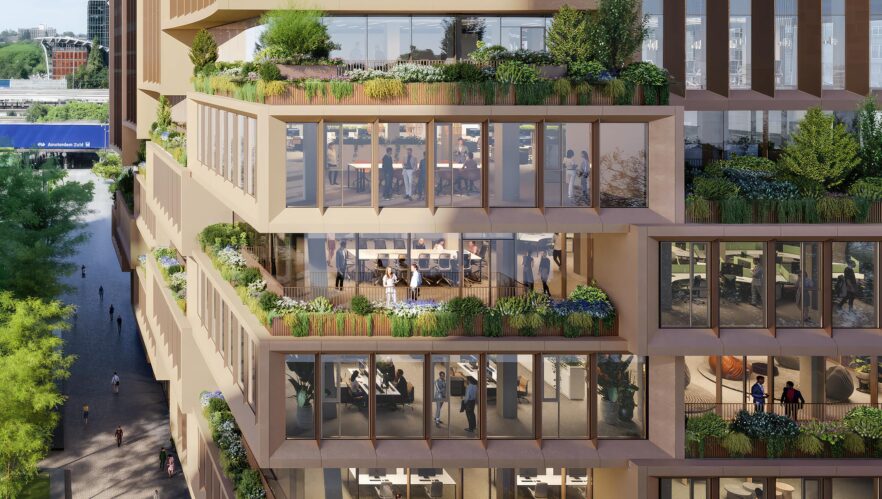
The façade of Mahler 1 has been designed to do more than just shape the building’s appearance. It contributes to a comfortable indoor climate, helps generate renewable energy and supports biodiversity through integrated planting. As a result, it plays an important role both in the building’s technical performance and in how it is experienced by users, local residents and passers-by.
A comfortable indoor climate through a smart façade
The design of the façade of Mahler 1 helps regulate temperatures in and around the building. Extensive studies of sunlight and solar exposure informed the design of the building’s distinctive scalloped form and the balance between open and closed façade elements. The fins on the outside have been positioned to provide shade helping to reduce heat gain, while also incorporating solar panels. This gives them a dual function: solar shading and the generation of renewable energy.
Greenery in and on the façade
The façade also provides space for greenery in the form of so-called Stepping Green Cuts – planted terraces and balconies that rise through the building and connect its amenity spaces at different levels. Green roofs and planted balconies have been incorporated throughout the design, creating a green link within the city that strengthens biodiversity.
The greenery helps birds, insects and other wildlife move through the area and find places to live. It also provides cooling on warm days and makes the surroundings more pleasant for people who work there or walk past.
Materials that look and are sustainable
Material selection has been an important part of the design process, prioritising materials with lower embodied carbon, while carefully considering their origin, weight, performance and suitability for the overall design.
The colours and textures of the façade take subtle cues from natural elements, such as tree bark, helping the building sit more naturally within its surroundings. The rounded forms further soften
the building’s appearance and make space for terraces, greenery and rainwater collection.
More than an outer layer
The façade of Mahler 1 shows how appearance, comfort and energy performance can work well together. The façade helps cool the building, generates energy and supports biodiversity, playing an important role in how the building functions and how it is experienced.